GHK-Cu
The gold standard in skin, collagen and hair research.
From $34.99 30% off
GHK-Cu is a naturally occurring copper tripeptide studied for its role in skin remodeling, collagen and elastin signaling, and tissue repair. Its declining levels with age have made it one of the most researched compounds in the beauty and longevity space.
What is GHK-Cu?
GHK-Cu is a copper peptide complex: the tripeptide glycine-histidine-lysine bound to a copper ion. It occurs naturally in human plasma, and plasma concentrations decline substantially with age, which is the observation that made it interesting to researchers in the first place.
The copper is not incidental. The complex carries the biological activity studied in the literature, and the peptide without its copper ion behaves differently. Any GHK-Cu for sale should be verified as the copper-bound complex rather than the bare tripeptide.
GHK-Cu research applications
This compound has the deepest published literature of anything in the skin and repair category, running back to the 1970s. Research covers collagen and elastin synthesis in fibroblasts, wound repair signalling, antioxidant and anti-inflammatory activity, and hair follicle signalling.
Notably, much of the foundational work came out of wound healing research rather than cosmetics. The skin appearance angle arrived later, downstream of studies that were originally about tissue repair.
How GHK-Cu works
The research describes GHK-Cu acting as a signalling molecule that influences gene expression related to tissue remodelling, alongside a role in copper transport. Copper is a required cofactor for lysyl oxidase, an enzyme involved in crosslinking collagen and elastin, which connects the copper-carrying function directly to the structural findings.
It is also visibly blue at meaningful concentrations. A colourless product claiming copper peptides is worth a second look.
GHK-Cu for sale: specifications
| Specification | Detail |
|---|---|
| Compound | GHK-Cu (copper tripeptide-1) |
| Class | Copper-bound tripeptide complex |
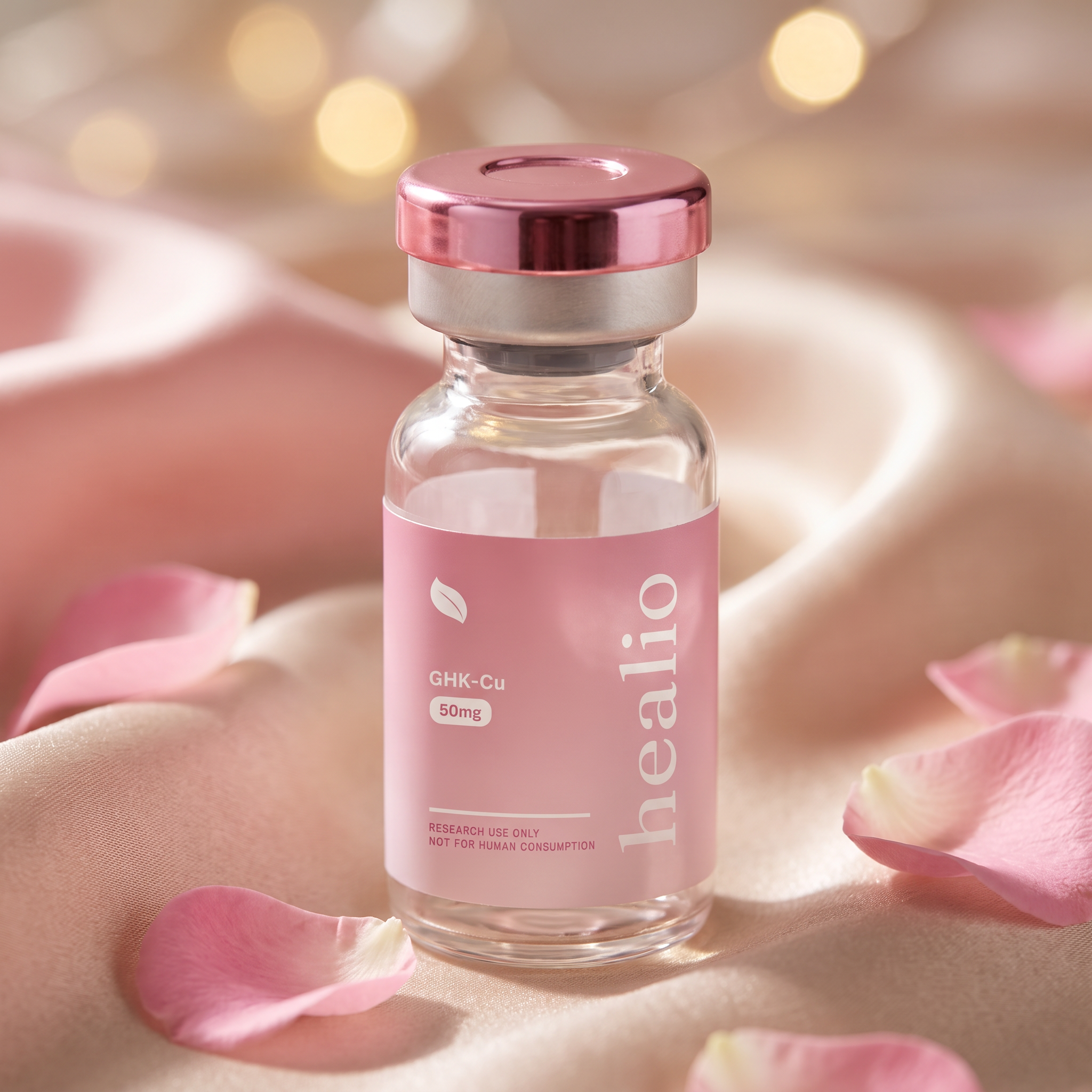
| Form | Lyophilized powder, sealed vial |
| Purity | Minimum 98%, verified by HPLC |
| Identity | Confirmed by mass spectrometry |
| Testing | Independent third-party laboratory, per batch |
| Origin | Shipped from the United States |
Research grade GHK-Cu vs cosmetic copper peptide serums
These are different products answering different questions. A cosmetic serum must be shelf-stable for years and pass regulatory requirements for leave-on products, which pushes formulations toward low active concentrations. Research-grade GHK-Cu is supplied as a lyophilized powder of stated purity with a certificate, because a laboratory needs to know the quantity it is working with.
The difference is not potency exactly. It is whether anyone can tell you what you have. Our full guide to copper peptides for skin covers the concentration question in detail.
Reconstitution and handling
Supplied lyophilized. Reconstitute with bacteriostatic water, adding diluent slowly against the vial wall and allowing the powder to dissolve without agitation. Bacteriostatic water is available separately.
Storage and stability
Store sealed lyophilized vials at minus 20 degrees Celsius, protected from light. Copper complexes are light-sensitive, so protection from light matters more here than for some other compounds. Reconstituted solution requires refrigeration and a shorter window.
Certificate of analysis for every batch
For a copper complex, both purity and identity testing matter, because a peptide that is not correctly copper-bound is a different substance. Every batch is tested by an independent US laboratory for HPLC purity to a minimum of 98% and mass spectrometry identity, with the certificate published at our research page before purchase.
Why researchers buy GHK-Cu from Healio
Independent verification published in advance, minimum 98% purity, mass spectrometry identity confirmation, and US dispatch. GHK-Cu is also the largest component of the GLOW 70 and KLOW 80 blends at 50mg per vial, and the wider category sits under peptides for skin and beauty.
GHK-Cu FAQ
What is GHK-Cu used for in research?
Collagen and elastin synthesis studies, wound repair research, antioxidant signalling and hair follicle work. Supplied as a laboratory research material only.
What does GHK-Cu do for skin in the research?
Published work examines stimulation of collagen and elastin production in fibroblasts, alongside wound repair signalling. A large share of that research is in cell culture rather than human trials, which is worth keeping in mind when reading stronger claims.
Is GHK-Cu the same as copper peptides in skincare?
It is the same molecule, at very different concentrations and in a very different format. Cosmetic formulations are constrained by shelf stability and regulatory requirements for leave-on products.
How is Healio GHK-Cu verified?
Independent third-party HPLC purity to a minimum of 98% and mass spectrometry identity confirmation, published per batch before purchase.
Research focus
- Skin firmness and radiance research
- Collagen and elastin support studies
- Hair follicle and scalp research
- Healthy-aging and tissue-repair models
Who it’s for
For researchers focused on
| Scientific name | Copper Tripeptide-1 |
|---|---|
| CAS number | 89030-95-5 |
| Molecular formula | C14H22CuN6O4 |
| Molecular weight | 403.9 g/mol |
| Sequence | Gly-His-Lys : Cu(II) |
| Purity | 98%+ (HPLC) |
| Form | Lyophilized powder |
| Appearance | White to off-white powder |
Store the lyophilized powder at -20u00b0C, protected from light. Brief exposure to room temperature during shipping does not affect stability.
After reconstitution, keep refrigerated at 2 to 8u00b0C and use within the research window. Do not freeze the reconstituted solution.
For laboratory research use only. Reconstitute with bacteriostatic water and handle with appropriate protective equipment.
-
EssentialBest Seller
Bacteriostatic Water 10ml
Sterile Reconstitution Water
$9.99SizeAdd to Cart10 mL -
EnergyBest Seller
MOTS-c
Metabolic + Mitochondrial Support
$59.99SizeAdd to Cart10mg -
LibidoBest Seller
PT-141
Libido + Intimacy Support
$34.99SizeAdd to Cart10mg -
WeightBest Seller
Retatrutide
Advanced Fat-Loss Support
From $78.99This product has multiple variants. The options may be chosen on the product pageSizeAdd to Cart