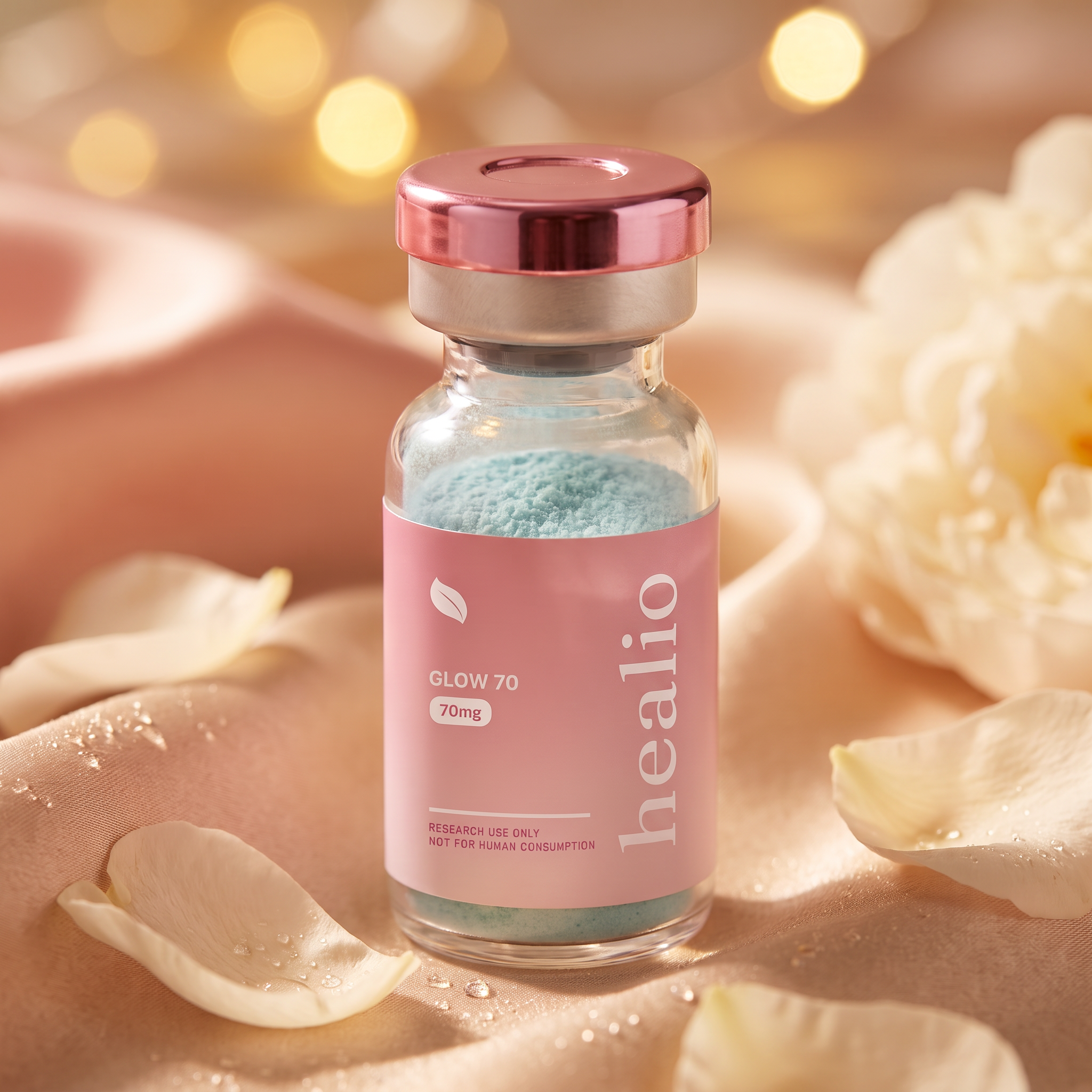
GLOW 70
Three repair peptides, one 70mg vial.
$104.99 30% off
GLOW 70 is a three-peptide blend in a single 70mg vial: 50mg GHK-Cu, 10mg BPC-157 and 10mg TB-500. It brings together the compounds most studied for collagen synthesis, blood supply into repairing tissue, and cell migration, so a research protocol covering all three mechanisms takes one reconstitution instead of three.
What is GLOW 70?
GLOW 70 is a three-peptide research blend supplied as a single 70mg vial: 50mg GHK-Cu, 10mg BPC-157 and 10mg TB-500. One vial, one reconstitution, three compounds that the tissue repair literature has studied independently for decades.
The name is simply the arithmetic. Seventy milligrams total, weighted heavily toward the copper peptide, which is the component with the deepest published record behind it.
What is in GLOW 70
| Compound | Amount | Mechanism studied |
|---|---|---|
| GHK-Cu | 50 mg | Collagen and elastin synthesis, extracellular matrix remodelling |
| BPC-157 | 10 mg | Angiogenesis and connective tissue repair signalling |
| TB-500 | 10 mg | Actin polymerisation and cell migration |
Why these three are blended together
Each compound approaches tissue repair from a different mechanism. GHK-Cu acts as a signalling molecule influencing gene expression around remodelling, and carries copper as a required cofactor for lysyl oxidase, the enzyme that crosslinks collagen and elastin. BPC-157 is studied principally for angiogenesis, the formation of new blood supply into repairing tissue. TB-500 works on actin, the structural protein that governs how cells migrate into a site that needs rebuilding.
Structure, blood supply, and the cells that do the work. That is the logic, and it is a reasonable one.
What it is not is a demonstrated combination. Published studies of these three compounds administered together do not exist. The blend is mechanistically coherent rather than clinically proven, and saying so plainly is more useful than implying a synergy nobody has tested.
GLOW 70 research applications
Research interest in this combination sits across skin structure and collagen work, wound and connective tissue repair models, and healthy-ageing studies where extracellular matrix quality is the endpoint. GHK-Cu alone accounts for the bulk of that literature, running back to the 1970s and originating in wound healing research rather than cosmetics.
Supplied as a laboratory research material only.
GLOW 70 for sale: specifications
| Specification | Detail |
|---|---|
| Contents | GHK-Cu 50mg, BPC-157 10mg, TB-500 10mg |
| Total | 70 mg per vial |
| Form | Lyophilized powder, single sealed vial |
| Appearance | Blue to blue-green powder, from the copper complex |
| Purity | Minimum 98% per component, verified by HPLC |
| Identity | Confirmed by mass spectrometry |
| Testing | Independent third-party laboratory, per batch |
| Origin | Shipped from the United States |
GLOW 70 versus buying the three vials separately
The practical difference is reconstitution. Three separate vials means three diluent volumes, three concentrations to track and three sets of handling. A blend fixes the ratio at the point of manufacture, which removes that arithmetic but also removes the ability to vary one component independently.
If a protocol needs to adjust GHK-Cu without touching the others, buy the vials separately. If the ratio above is the ratio you want, the blend is fewer steps and a lower combined cost.
Reconstitution and handling
Supplied lyophilized. Reconstitute with bacteriostatic water, adding diluent slowly against the vial wall and allowing the powder to dissolve without agitation. Never shake, as peptides degrade under shear force.
Because the blend is a fixed ratio, the reconstitution volume you choose sets the concentration of all three components at once.
Storage and stability
Store the sealed lyophilized vial at minus 20 degrees Celsius, protected from light. Copper complexes are light-sensitive, so light protection matters more for this blend than for most single peptides. Reconstituted solution requires refrigeration at 2 to 8 degrees Celsius and a shorter usable window. Do not freeze the reconstituted solution.
Certificate of analysis for every batch
A blend is only as verifiable as its weakest component, so each of the three is tested rather than the mixture being assayed as a single substance. Every batch is tested by an independent US laboratory for HPLC purity to a minimum of 98% per component and mass spectrometry identity, with the certificate published at our research page before purchase.
Why researchers buy GLOW 70 from Healio
Independent verification published in advance, minimum 98% purity per component, mass spectrometry identity confirmation, and US dispatch. The wider category sits under peptides for skin and beauty, and researchers wanting the anti-inflammatory component as well should look at KLOW 80, which adds 10mg of KPV to the same three.
GLOW 70 FAQ
What is in the GLOW 70 blend?
50mg GHK-Cu, 10mg BPC-157 and 10mg TB-500 in a single 70mg vial, supplied as a lyophilized powder.
What is the difference between GLOW 70 and KLOW 80?
KLOW 80 is the same three peptides with 10mg of KPV added, bringing the total to 80mg. KPV is an anti-inflammatory tripeptide fragment of alpha-MSH, so the difference is an inflammation signalling component the three-peptide version does not have.
Why is the GLOW 70 powder blue?
GHK-Cu is a copper-bound complex and is visibly blue at meaningful concentrations. At 50mg of the 70mg total it dominates the colour. A colourless product sold as a GHK-Cu blend is worth a second look.
Is the GLOW 70 combination supported by research?
The three compounds individually have substantial published literature. The combination as a single formulation does not have dedicated studies behind it. The pairing is based on complementary mechanisms rather than trial data.
How is Healio GLOW 70 verified?
Independent third-party HPLC purity to a minimum of 98% per component and mass spectrometry identity confirmation, published per batch before purchase.
Research focus
- Skin, collagen and elastin research
- Wound and connective tissue repair models
- Extracellular matrix remodelling studies
- One vial instead of three reconstitutions
Who it’s for
For researchers focused on
| Scientific name | GHK-Cu + BPC-157 + TB-500 |
|---|---|
| CAS number | Blend, see components |
| Molecular formula | Multi-component |
| Molecular weight | Multi-component |
| Sequence | GHK-Cu 50mg + BPC-157 10mg + TB-500 10mg |
| Purity | 98%+ per component (HPLC) |
| Form | Lyophilized powder |
| Appearance | Blue to blue-green powder |
Store the lyophilized powder at -20u00b0C, protected from light. Brief exposure to room temperature during shipping does not affect stability.
After reconstitution, keep refrigerated at 2 to 8u00b0C and use within the research window. Do not freeze the reconstituted solution.
For laboratory research use only. Reconstitute with bacteriostatic water and handle with appropriate protective equipment.
-
EssentialBest Seller
Bacteriostatic Water 10ml
Sterile Reconstitution Water
$9.99SizeAdd to Cart10 mL -
WeightBest Seller
Semaglutide
Appetite + Weight Support
From $79.99This product has multiple variants. The options may be chosen on the product pageSizeAdd to Cart -
Repair BlendBest Seller
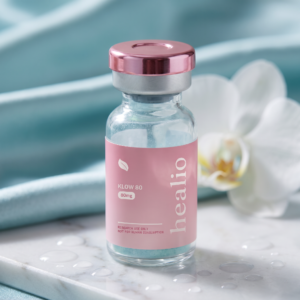
KLOW 80
Repair + Anti-Inflammatory Blend
$119.99SizeAdd to Cart80mg -
WeightBest Seller
Retatrutide
Advanced Fat-Loss Support
From $78.99This product has multiple variants. The options may be chosen on the product pageSizeAdd to Cart